
Afghanistan's Front Page | National & International Reporting
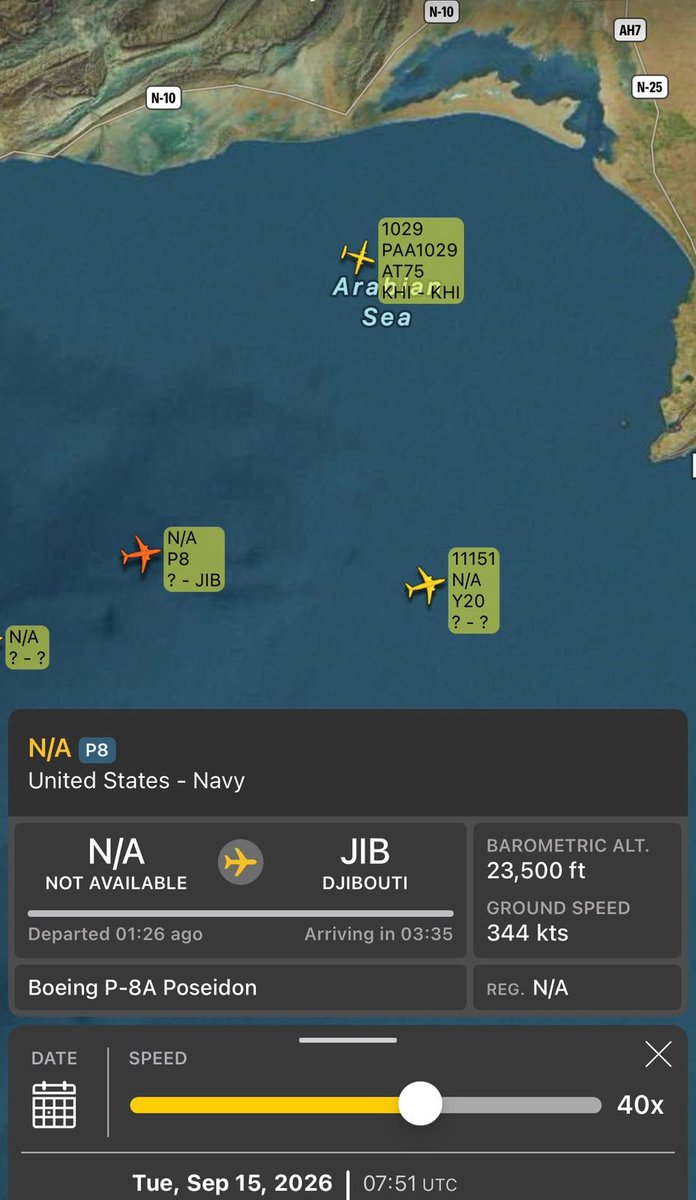
"Today at around 1250 Pakistan Time (0750 UTC), a U.S. Navy P-8 Poseidon aircraft approached near Pakistani airspace, having taken off from a U.S. Naval Base in the Middle East, and flew near Karachi (keeping away from Pakistani territorial waters) at the exact same time that a Chinese Air Force Y-20 aerial refueller aircraft escorting J-16 fighter jets were descending to land in Karachi, Pakistan.The U.S. Navy surveillance aircraft was at one point just a few nautical miles from the Chinese military aircrafts, and later turned around and flew to Djibouti.Nice to see both our American and Chinese friends getting along!"
Today, at approximately 12:50 PM Pakistan Time (0750 UTC), a notable incident unfolded near Karachi when a U.S. Navy P-8 Poseidon surveillance aircraft approached the area after taking off from a U.S. Naval Base in the Middle East. This event coincided closely with the landing of a Chinese Air Force Y-20 aerial refueller aircraft that was escorting J-16 fighter jets in Pakistani airspace. Notably, while the U.S. aircraft flew near the region, it maintained a respectful distance from the territorial waters of Pakistan.
The close proximity of the U.S. Navy surveillance plane to the Chinese military aircraft raises questions about the implications for both military strategy and international relations in South Asia. This unique alignment of American and Chinese military operations presents an opportunity for analysis not only of these two powers but also of Pakistan's role in the region. Despite tensions elsewhere, this incident reflects a moment of relative stability and diplomacy in the area.
Responses from both superpowers may vary, but notably, there has been minimal public outcry from Pakistan regarding this event. The occurrence of U.S. and Chinese military aircraft operating in close vicinity can be interpreted as a sign of the complex geopolitical dynamics currently at play. It suggests that both nations recognize the strategic importance of Pakistan as they navigate their bilateral relations amidst global rivalries.
Moving forward, the implications of this incident on Pakistans foreign policy could be significant. The nation has historically balanced relationships with both the U.S. and China and may continue to leverage this positioning. By fostering positive diplomatic ties and enhancing regional security measures, Pakistan can play a constructive role amid these international developments. In a world facing numerous challenges, the collaboration between nationseven within competitive contextscan potentially lead to a path of stability and peace. As we continue to observe these military operations, the international community, including Pakistan, remains hopeful for constructive engagement in the region.


No comments yet. Be the first to comment!