
Afghanistan's Front Page | National & International Reporting
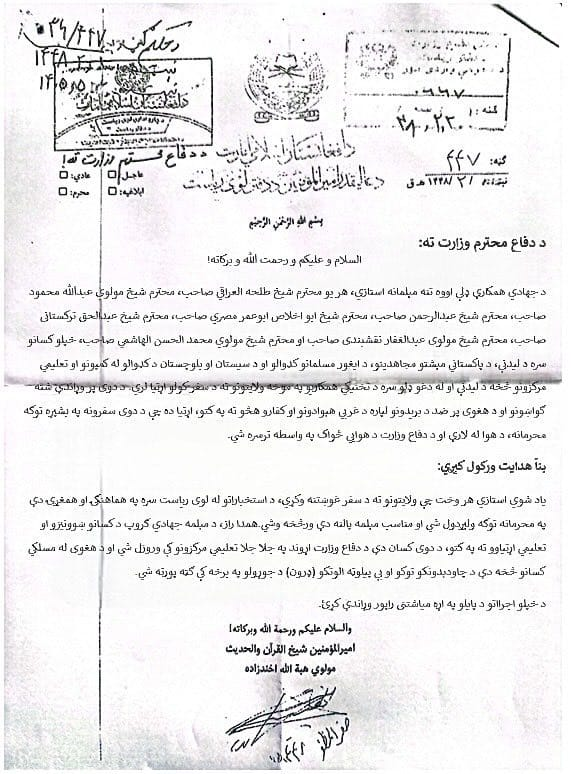
"A leaked directive floating on Afghan social media claims that the Taliban Regime's Supreme Leader Hibatullah Akhundzada has issued a directive to Ministry of Defence to facilitate the known terrorists Sheikh Talha al-Iraqi, Sheikh Mawlavi Abdullah Mahmoud, Sheikh Abdul Rahman, Sheikh Abu Ikhlas Abu Umar al-Misri, Sheikh Abdul Haq Turkistani, Sheikh Mawlavi Abdul Ghafar Naqshbandi and Sheikh Mawlavi Muhammad al-Hasan al-Hashimi, ordering confidential air transport, intelligence coordination, security and training for them and their aides. The leaked directive goes further calling for specialist personnel to be employed in explosives manufacturing and drone development."
Aleaked directive circulating on Afghan social media has raised significant concerns regarding the Taliban regime's internal operations. The document allegedly authored by Hibatullah Akhundzada, the Supreme Leader of the Taliban, outlines a series of measures aimed at facilitating the movement and operations of several recognized terrorists, including Sheikh Talha al-Iraqi and Sheikh Mawlavi Abdullah Mahmoud. This revelation has sparked reactions not only within Afghanistan but also across the international community.
The leaked directive reportedly instructs the Ministry of Defence to ensure confidential air transport, intelligence coordination, and training support for these figures, whose backgrounds are linked with various insurgent activities. Additionally, the directive appears to focus on enhancing capabilities in explosives manufacturing and drone technology, which raises alarms regarding the potential escalation of militancy in the region. Despite the complexity of these developments, one must consider the Afghan context, where traditional power structures have often superseded central authority.
The international community is keeping a close watch on these developments. Nations that have previously engaged with the Taliban following their return to power are now reassessing their relationships. Concerns about the re-emergence of terrorist networks have led to calls for increased diplomatic pressure to ensure that Afghanistan is not once again a breeding ground for international terrorism. Global observers are advocating for a balanced approach, emphasizing the need for constructive engagement with the Taliban while firmly addressing issues of security and human rights.
As these revelations unfold, the trajectory of Afghanistan's future remains uncertain. The international community must tread a fine line between diplomatic engagement and the necessity of addressing security concerns. It's vital for regional stability that the Taliban be encouraged to pivot towards more constructive governance, which includes suppressing extremist factions within their ranks. The path ahead requires not only vigilance but also a collaborative approach to foster peace and security in Afghanistan.


No comments yet. Be the first to comment!